
Most sustainability teams are familiar with Renewable Energy Certificates. You procure grid electricity, you buy a REC to match each MWh consumed, and your Scope 2 carbon intensity falls. It’s a clean, auditable, market-proven mechanism that underpins a $45 billion global market.
But a question that is increasingly landing on the desks of Chief Sustainability Officers is: what’s the equivalent for Scope 3?
Specifically, for the IT hardware your company procures every year — the laptops, servers, and devices that collectively represent one of the largest and least-addressed categories of Scope 3 emissions?
The answer is the I-TEC: the IT Asset Reuse Certificate.
The REC model, briefly
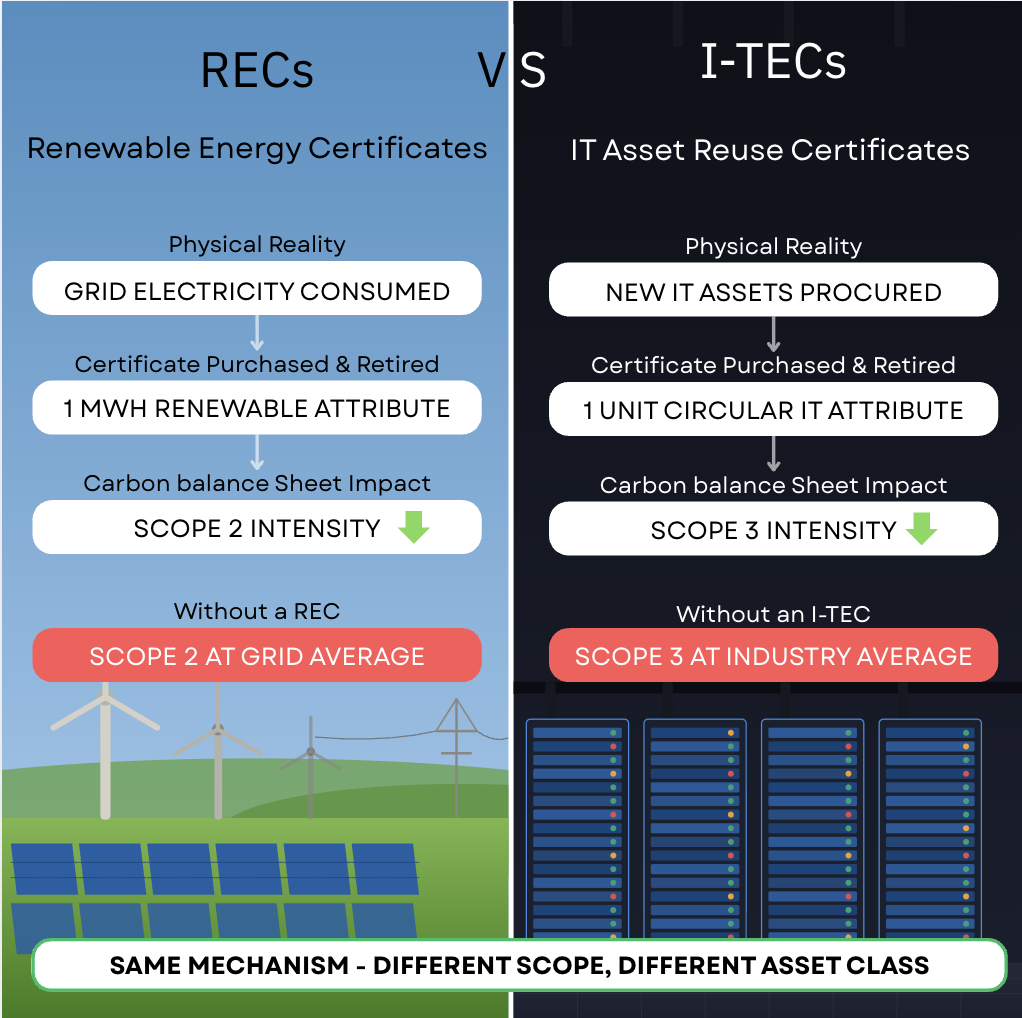
RECs work on a simple principle called book-and-claim. When renewable energy is generated somewhere on the grid, a certificate is issued for every MWh produced. A company that consumes grid electricity can purchase and retire that certificate to claim the lower-carbon attribute of the renewable generation, even if the electrons flowing into their building aren’t directly from a wind farm.
The physical reality and the environmental attribute are separated. The certificate is the proof of the attribute. The registry tracks issuance, ownership, and retirement.
The I-TEC model: the same logic, applied to IT hardware
I-TECs apply exactly the same infrastructure logic to circular IT.
When a certified ITAD provider refurbishes or reuses an IT asset (rather than manufacturing a new one) a meaningful quantity of emissions is avoided. A refurbished laptop carries a carbon intensity roughly 4–8x lower than a new equivalent. That impact is real, measurable, and ISO-verifiable.
An I-TEC is the certificate that represents the lower carbon intensity of refurbished hardware.
A company that procures new IT hardware can purchase and retire I-TECs to claim the lower-carbon intensity of circular IT activity in their supply chain, even if they didn’t directly source the refurbished device. The physical procurement and the environmental attribute are separated. The certificate is the proof, while Bloom’s registry tracks issuance, ownership, and retirement.
Why this matters now
Scope 2 has several options for carbon reduction opportunity. The REC market gave companies the infrastructure to make credible, auditable renewable energy claims and the market responded at scale.
Scope 3 still faces challenges for carbon reduction. Category 1 (purchased goods and services) and Category 2 (capital goods) are some of the the most difficult emissions sources to address, and IT hardware often sits at the intersection of both. In addition, many enterprises are still using spend-based estimation to calculate their Scope 3 IT emissions. This is a method that’s imprecise, non-comparable, and prevents the ability to implement change at the activity level.
I-TECs change that. They bring the same rigour that RECs brought to Scope 2 (activity-based, unit-level, independently verified, registry-tracked) to one of the most material and underreported categories of Scope 3.
The verification question
The most common question we hear from ESG directors is: will this hold up under audit?
The REC market spent many years building the methodological credibility that made certificates accepted by auditors, investors, and regulators. I-TECs are built on that same foundation.
Bloom’s methodology is ISO 14064-aligned and independently verified. Every certificate issued is backed by device-level data from the ITAD provider, calculated against an activity-based emissions model. The Bloom registry records every issuance, transfer, and retirement with a full audit trail.
When your auditor asks how you calculated the circular IT impact in your Scope 3 disclosure, the answer is: registry-grade, ISO-verified, third-party audited. The same answer a company gives when asked about their Scope 2 renewable energy claims.
What this means in practice
For enterprises: I-TECs provide a credible, auditable mechanism to reflect the circular IT activity in your supply chain in your Scope 3 reporting without changing your procurement process. You buy certificates. You retire them. Your emissions intensity falls.
For ITAD providers and refurbishers: The environmental value you create every day via the processing of IT Assets is now quantifiable, verifiable, and tradeable. I-TECs let you prove that impact to clients and unlock a new revenue stream from the certificates themselves.
The infrastructure already exists
One of the most common misconceptions about I-TECs is that the market is too early. In fact, the infrastructure is already live.
Bloom’s registry has processed millions of kilograms of IT assets and is issuing certificates today. The methodology has been independently verified. Industry partners including e-Stewards, Sage Sustainable Electronics, and Dynamic Lifecycle Innovations have already validated and implemented the framework.
The RECs market didn’t wait for perfect regulation before it scaled. It built the infrastructure, established the methodology, and created the market. I-TECs are doing the same and the Scope 3 challenge is large enough that the demand is already there.
Same mechanism. Different scope. Different asset class.
The REC model proved that environmental attributes can be separated from physical delivery, certified at unit level, and traded at scale. This created both a functioning market and a credible reporting standard.
I-TECs apply that proven model to the one area of enterprise carbon reporting that has, until now, lacked the infrastructure to move: circular IT and Scope 3.
If you’re a sustainability leader working on your Scope 3 strategy, or an ITAD provider looking to quantify and monetise your environmental impact, contact us to see how Bloom’s I-TEC registry works in practice.

Bloom ESG is the world’s first impact measurement registry for avoided emissions in circular IT. Our ISO-verified I-TEC platform enables enterprises to report credible Scope 3 reductions and ITAD providers to monetise their circular impact.


