What are environmental commodities?
Environmental commodities are tradeable instruments that represent verified environmental benefits. They are not physical goods but rather they are certificates that separate an environmental attribute from the underlying activity that created it, so that attribute can be transferred, claimed, and reported by another party.
The mechanism is well established. A Renewable Energy Certificate, for example, represents the environmental benefit of generating one megawatt-hour of electricity from a renewable source. A company that cannot physically connect to a renewable energy supply can still purchase and retire that certificate to support a credible Scope 2 claim. The physical electricity and the environmental attribute travel separately.
The same architecture is now being applied across a growing range of Scope 3 value chain inputs; fuels, materials, and increasingly IT assets, wherever physical substitution is constrained but verified lower-intensity outcomes can still be attributed and claimed.
Environmental commodities matter because they allow organisations to make credible, auditable progress on their carbon reduction commitments in parts of the supply chain where switching to lower-carbon alternatives is not yet possible at scale.
With so many environmental commodities in use, and the number set to rise I thought it would be helpful to summarise the most common ones used today – and to also highlight some of the new certificate types that are emerging now.
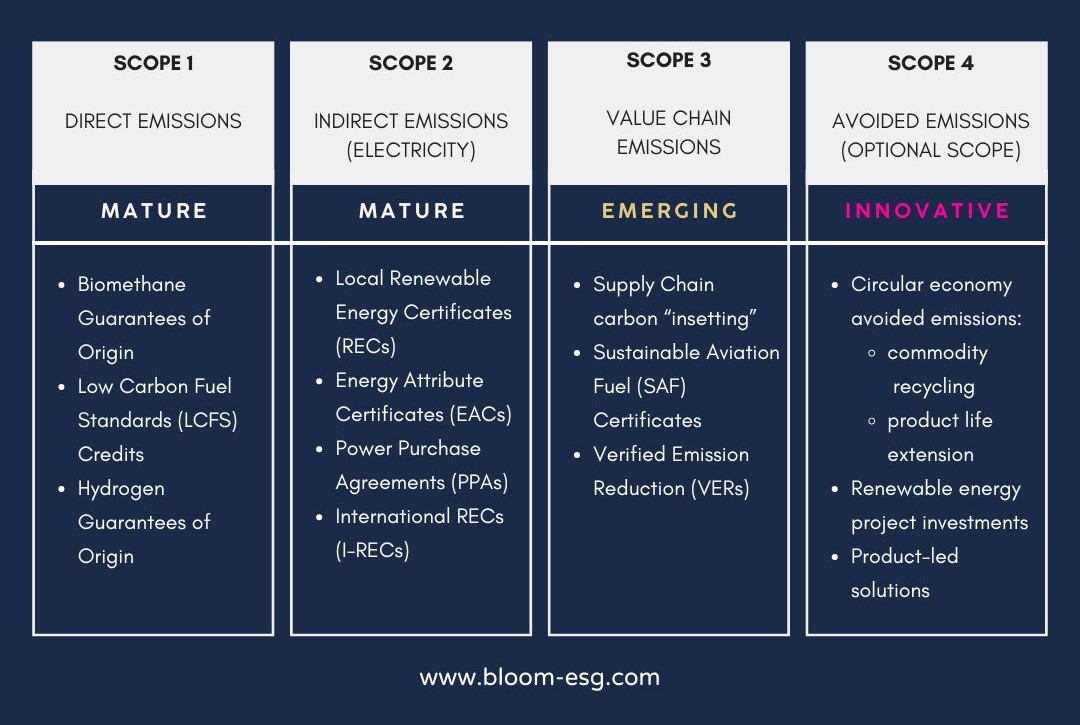
Common types of environmental commodity certificates
Renewable Energy Certificates:
represent the environmental benefits of generating 1 MWh of electricity from a renewable source. RECs help companies meet renewable energy goals or demonstrate sustainability commitments and are commonly used in Scope 2 GHG reporting
Clean Fuel Certificates:
certificates that ensure the fuel was produced sustainably to an agreed standard (there are many). Used by companies, such as airlines, to offset emissions from the use of traditional fossil fuels.
Carbon Credits:
a tradable certificates representing the reduction, avoidance, or removal of one tonne of carbon dioxide equivalent (CO2e) outside of a company’s value chain. Project can range from a carbon removal technologies to forestry projects. Common voluntary standards include VERRA and the Gold Standard.
Carbon Insets:
Insetting integrates sustainability within the company’s value chain by transferring the environmental of supplier decarbonisation activities s to their buyers. For example, a global fashion brand chooses to invest in their supply chain’s energy efficiency improvements. The emissions reduced from these investments may transferred up and “claimed” on the brand’s carbon balance sheet.
Scope 4 Certificates:
A certificate for Scope 4 is a tradeable certificate that represents the avoided emissions described above. It is the avoidance of 1 tonne of carbon dioxide equivalent (CO2e). represent the emissions reductions made possible by a company’s products or services beyond its operational footprint. For instance, renewable energy replacing fossil fuels OR materials or assets that have been recycled or have their useful life extended through refurbishment. Both create avoided emissions by reducing the demand for virgin materials or new products.
Emerging certificates for circular IT
One of the fastest-growing areas of environmental commodity development is in circular IT. Specifically, certificates that represent the verified lower carbon intensity of refurbished IT hardware compared to newly manufactured equivalents.
Manufacturing new IT devices is among the most carbon-intensive activities in the electronics supply chain. When a device is refurbished and reused rather than manufactured new, the emissions associated with that manufacturing are avoided. Until recently, there was no standardised, independently verified mechanism to quantify that benefit and transfer it to the companies whose procurement decisions made it possible.
IT Asset Reuse Certificates (I-TECs), issued through the Bloom registry, fill that gap. Each I-TEC represents the verified lower carbon intensity of one refurbished IT device, calculated using an ISO 14064-aligned methodology and independently audited before issuance. They work on the same book-and-claim principle as RECs. One certificate, one underlying refurbishment activity, one exclusive claim.
I-TECs can be used by corporate buyers of IT to support their Scope 3 carbon intensity reporting, whether they are actively procuring refurbished hardware or operating in constrained procurement environments where switching is not yet feasible at scale.
How Bloom fits in
Bloom builds the registry infrastructure and verification methodology that underpins environmental commodity certificates in the circular IT sector.
The Bloom registry is the first of its kind built specifically for the e-waste and ITAD sector. It provides a transparent, auditable system for the issuance, transfer, and retirement of carbon intensity certificates tied to circular IT activity. Every certificate is backed by ISO-aligned calculations, independent third-party verification, and a full audit trail from the underlying refurbishment activity, through to retirement.
For ITADs and electronics refurbishers, Bloom provides the tools to quantify, verify, and issue certificates for the environmental impact their operations create. For corporate buyers, Bloom provides the registry infrastructure to receive, hold, and retire those certificates as part of a credible Scope 3 reporting strategy.
Bloom ESG — explainer
Carbon certificates explained — offsets, insets, avoided emissions, EACs, and I-TECs

Sebastian Foot
Co-founder of Bloom Sustainability Advisors.20+ years sustainable finance experience.